
What’s up everyone? Red and black is my favorite color, but blue isn’t far off. If we’re talking Duke blue though, you’re asking the wrong guy. I’m a Tarheel basketball fan and the last thing I want to talk about is Duke basketball. However, I have no issue with Duke Football. They were more interesting to watch in certain matchups per season. Before then, I had no idea who they were as a football team.
A BRIEF RUNDOWN
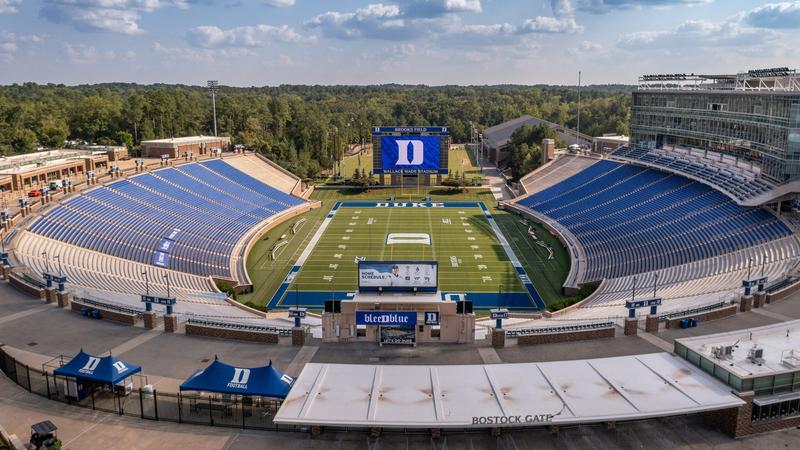
So, why am I talking about the Duke Blue Devils football program? Growing up, I heard so much about Duke basketball, but I was curious about their football program. They were anything but prominent, formidable, or even relevant. Since I was born in 1990, they were continuing as the consistent bottom feeders of the ACC and college football. It doesn’t matter if they were in the Coastal or Atlantic, they weren’t intimidating anyone. It continued that way until David Cutcliffe took over in 2008 (after I graduated high school). After some time, Cutcliffe brought the program back to relevance. Before I go any further, I want to talk about Duke’s football history and what became of their program from the Independent (1922) to the Southern Conference (1928), and up to the ACC (1953).
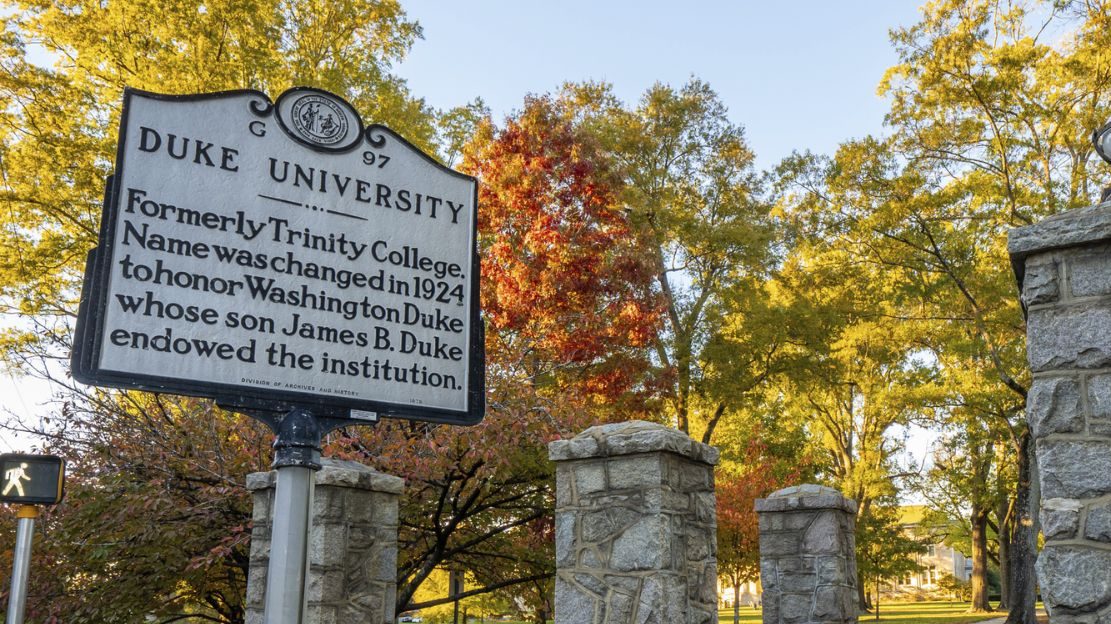
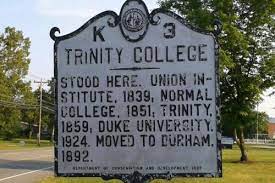
Before Duke officially competed 101 seasons ago, they were called the Trinity Blue and White back in 1888. Their first ever game was against none other than their rival, North Carolina, which was a “scientific game”. After some competition (1888-1895, 1920-1921) and hiatus (1895-1919), they took their competition to the Independent level and changed their name to the Trinity College. It eventually changed to what we know now as the Duke Blue Devils. Between 1922 and 1925, they went through four head coaches before Jimmy DeHart became the first ever long-term head coach through the Independent and parts of the Southern Conference in the early 1930s. After him, one coach arrived and changed everything for the program.
THE WALLACE WADE ERA
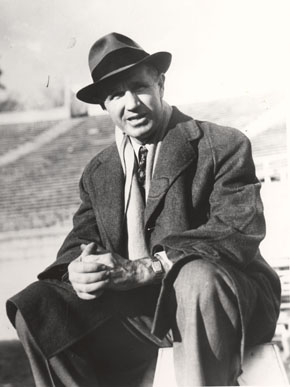
Prior to Duke’s recent success in 2012, my biggest question “was Duke football ever good back then?” Yes! Over 90 years ago, Duke was a strong program in their own right thanks to legendary coach Wallace Wade. He led the Blue Devils from 1928 to 1941 and 1946 to 1950. Prior to his arrival at Durham, he coached Alabama from 1923 to 1930. He was successful at Tuscaloosa but chose to leave for Duke because his philosophy would work with Duke administration’s philosophy, and he felt he would have more freedom at a private institution. He was smart by sending his former Bama players/future assistants to Duke a year before Wade’s arrival. During his tenure, Duke had massive success with 110 wins to 36 losses and seven ties. He coached two stints because he served in World War II after the 1941 season after the Pearl Harbor bombing. Even the Rose Bowl game against USC was moved to Durham because of it. The Blue Devils’ best years were in 1933 (9-1), 1936 (9-1), 1938 (9-1), 1939 (8-1), and 1941 (9-1). He only had one losing season in his first season back from war (1946). The program’s highest AP Poll was #2 in 1936 and 1941, and they had one preseason AP ranking appearance in his last year of coaching in 1950. They appeared in two bowls (both Rose Bowl), but unfortunately lost both. One season in Duke’s history that was rarely mentioned and needs more attention was in 1938 when Duke was undefeated, untouched, and unblemished in the regular season before their one and only loss in the Rose Bowl to USC.
THE IRON DUKE (1938)

Duke’s best year of their entire existence was in 1938. They were called the Iron Dukes, coached by Wallace Wade, when they went undefeated and never allowed a single point in the regular season until the Rose Bowl. This was the first and last time Duke allowed a touchdown (and even a point) in their entire season. Their success in that year alone put Duke on the map. The team also had two backfield players (and brothers) that came from Ironton, Ohio in George and Wesley McAfee. They both went to the NFL, but George went to the Hall of Fame in 1966 after winning three championships with the Chicago Bears. George also served in World War II. I’ll also leave you with the 1938 scores that showed why they were called the Iron Dukes.

POST-WALLACE WADE ERA
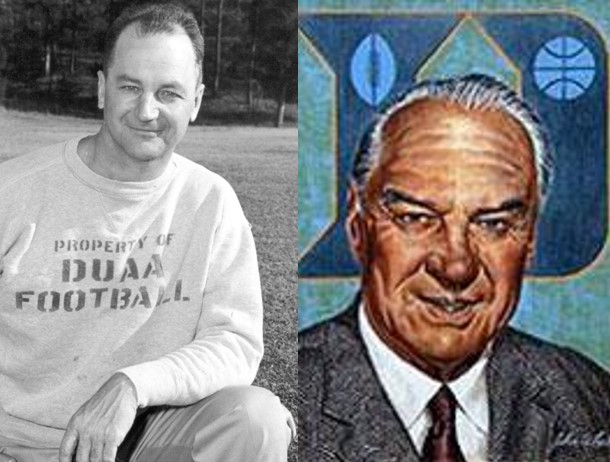
When Wallace Wade stepped down from coaching to serve in World War II, Eddie Cameron stepped in as a short-term football coach (1942-1945) after coaching Duke basketball for 12 seasons (1928-1942). When Jimmy DeHart was hired as coach in 1926, he brought Cameron along. DeHart coached him when he was player back in Washington and Lee College. Once Wade took over, the admins convinced him to retain Cameron. Cameron was successful in both sports with six total Southern Conference titles (3 in football, 3 in basketball) and a Sugar Bowl victory over their former Southern Conference cohort, Alabama. If Wade didn’t serve in the war, he could’ve headlined the bowl involving two teams he coached for. Cameron Indoor Stadium was named after Eddie, and his accomplishments as a two-sport college coach showed why his name still exists in the infamous arena.

Bill Murray took over as head coach from 1951-1965. He coached the last two seasons in the Southern Conference before moving to the ACC and continuing his success there. He became the second winningest coach in Duke history behind Wallace Wade, compiling 93-51-9. He’s 2-1 in bowl games and is a 3-time ACC Coach of the Year. He’s the only Duke coach to win six ACC titles in program history. He was the very last Duke football coach during the 30-year run to keep Duke’s long-term success afloat. After Murray, Duke began their decline as they progressed into the Atlantic Coast Conference.
DUKE’S 46-SEASON DECLINE
Between the mid-1960s and the early 2010s, Duke was anything but good and their history during that span proves it. In their 46-season span, they were only ranked in three total seasons, posted eight winning seasons, appeared in two bowls (0-2), and won no more than eight games a season twice (thanks to Steve Spurrier and Fred Goldsmith). They had 17 straight losing seasons (1995-2011) with four winless seasons (1996, 2000-2001, 2006). In comes David Cutcliffe, who was briefly a part of the losing trend his first four seasons before guiding Duke to what was lost for decades: competing and winning consistently.
DAVID CUTCLIFFE ERA

David Cutcliffe rescued Duke from the bottom of the barrel and surprised the college football world for a good few seasons. He led Duke to their first ACC Coastal title, ACC title appearance, and won back-to-back ACC Coach of the Year honors. He manned a defense that played consistently well and allowed under 30 points for nine of his 13 seasons. Four of Cutcliffe’s starting quarterbacks helped Duke sustain the level of success. In Sean Renfree’s senior season, he helped Duke to their first postseason appearance in 18 years. Anthony Boone deserves a high honor from Duke University. He’s the winningest quarterback in program history, was the first Duke quarterback to lead the team to back-to-back bowl games, lead them to their first 10-win season in program history, and lead them to their first Top 25 ranking in 19 seasons. Thomas Sirk led Duke to their first bowl victory since the Cotton Bowl in 1960. Daniel Jones is not only the first Duke quarterback in history to win back-to-back bowl games, but he’s also the first Duke quarterback drafted in the first round since Dave Brown was a top Supplemental pick in 1992.
CONCLUSION
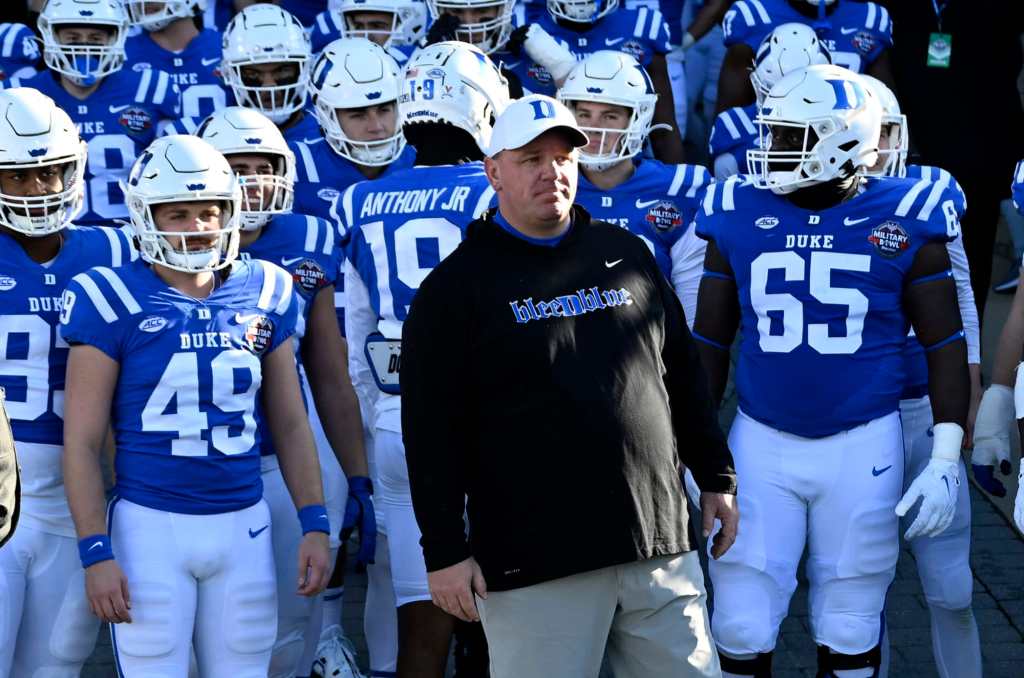
Looking back at everything Duke has done since they came to existence, they appeared in the football world tripping a bit before quickly succeeding for the next three decades with Jimmy DeHart, Wallace Wade, Eddie Cameron, and Bill Murray. During their tenure, they won or tied 69% of their games. After them, Duke only won or tied 29% of their games despite Steve Spurrier having short-term success. We’ll never if things went differently if Spurrier chose to stay. Duke was a former shell of what they were for almost five decades before David Cutcliffe came to the rescue. They won 49% of their games during his tenure (62-64), but he won the last three bowl games after losing his first three in his coaching career. Coach Mike Elko is currently in charge of Duke going into his second season, but he’s the first coach to win a bowl game in his first season with a winning record. More could be on the way for Duke with the roster he’ll have back this upcoming season.
 The Wolf's Cave
Leave a comment